Case Study

Unified Service Management: Salt River Project

A highly customized operational technology service management framework designed by 1898 & Co. is helping utility company Salt River Project strengthen reliability, enhance cybersecurity and accelerate its digital transformation through process consistency and operational excellence across the grid.


Challenge

Salt River Project (SRP), one of the nation’s largest public power utilities, launched a digital transformation in response to a pressing challenge: modernizing quickly enough to power its ambitious energy transition while simultaneously strengthening the operational resilience required to reliably serve the rapidly growing Phoenix region.

SRP is pursuing a strategic transformation across its generation, transmission and distribution operations. SRP’s strategy is to focus on modernizing people, processes and technology to create sustainable, secure and efficient power generation and delivery.

Recognizing that consistent and reliable operations depend on effective process management, SRP identified service management as a critical piece of the transformation. The challenge: Design and implement a scalable operational technology (OT) service management framework aligned with information technology (IT) and cybersecurity functions, tailored to the distinct needs of OT environments.


Read More  

Challenge

Salt River Project (SRP), one of the nation’s largest public power utilities, launched a digital transformation in response to a pressing challenge: modernizing quickly enough to power its ambitious energy transition while simultaneously strengthening the operational resilience required to reliably serve the rapidly growing Phoenix region.

SRP is pursuing a strategic transformation across its generation, transmission and distribution operations. SRP’s strategy is to focus on modernizing people, processes and technology to create sustainable, secure and efficient power generation and delivery.

Recognizing that consistent and reliable operations depend on effective process management, SRP identified service management as a critical piece of the transformation. The challenge: Design and implement a scalable operational technology (OT) service management framework aligned with information technology (IT) and cybersecurity functions, tailored to the distinct needs of OT environments.

Solution

To support SRP’s digital transformation, the utility partnered with 1898 & Co., part of Burns & McDonnell, to design and implement a vision, strategy and road map for SRT’s OT service management program. 1898 & Co. was selected as a trusted partner to design a scalable OT service management framework that integrates with IT and cybersecurity and is aligned with the utility’s operational priorities.

The goal of SRP’s collaboration with 1898 & Co. was to create a unified digital transformation approach, bridging IT, OT and cybersecurity to enhance reliability, efficiency and security across SRP’s generation, transmission and distribution operations.

Creating a Unified Vision for OT Service Management

The SRP and 1898 & Co. collaborative effort was anchored in integration, transparency and continuous improvement and set the stage for the development of robust OT service management capabilities.

The initiative began with defining a shared utility vision, followed by the implementation of a greenfield pilot at SRP’s high-security operations center (HSOC) and finally the development of a comprehensive strategy and road map designed to advance service management maturity across SRP’s power system. The result was a detailed implementation plan guiding SRP’s OT service management over a three-year time horizon. (Figure 1).
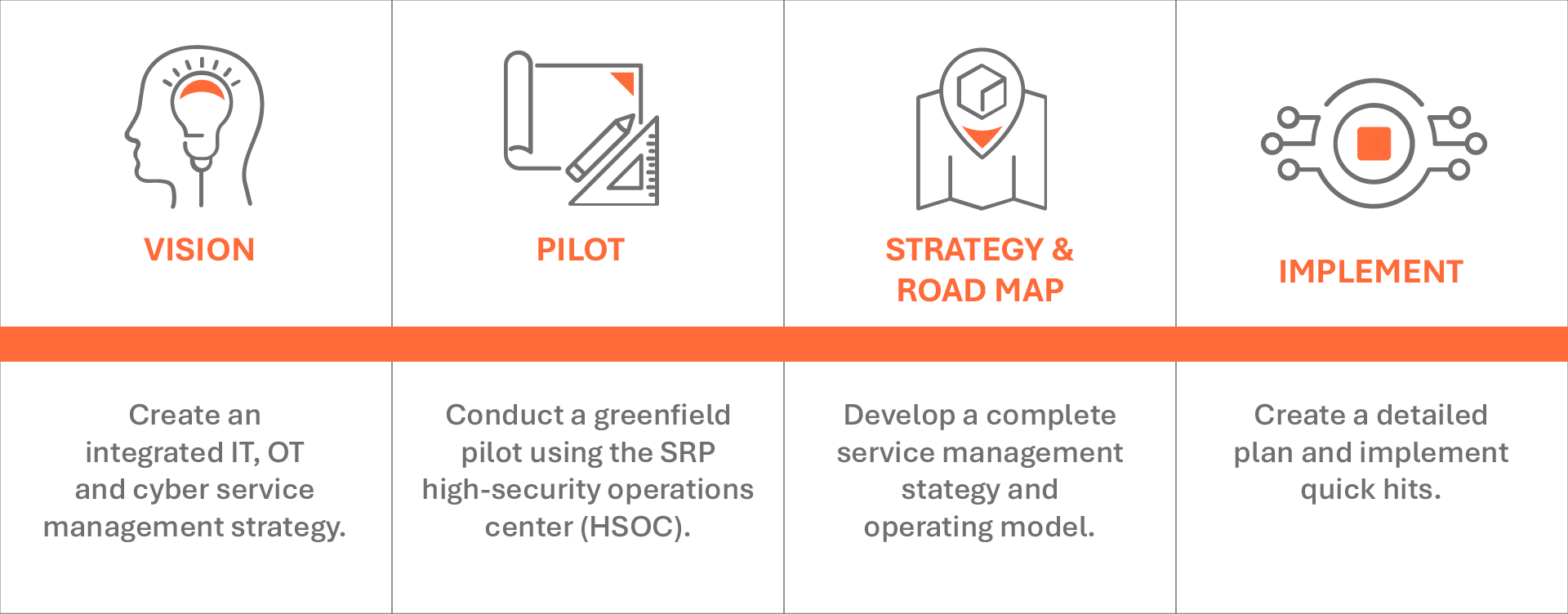
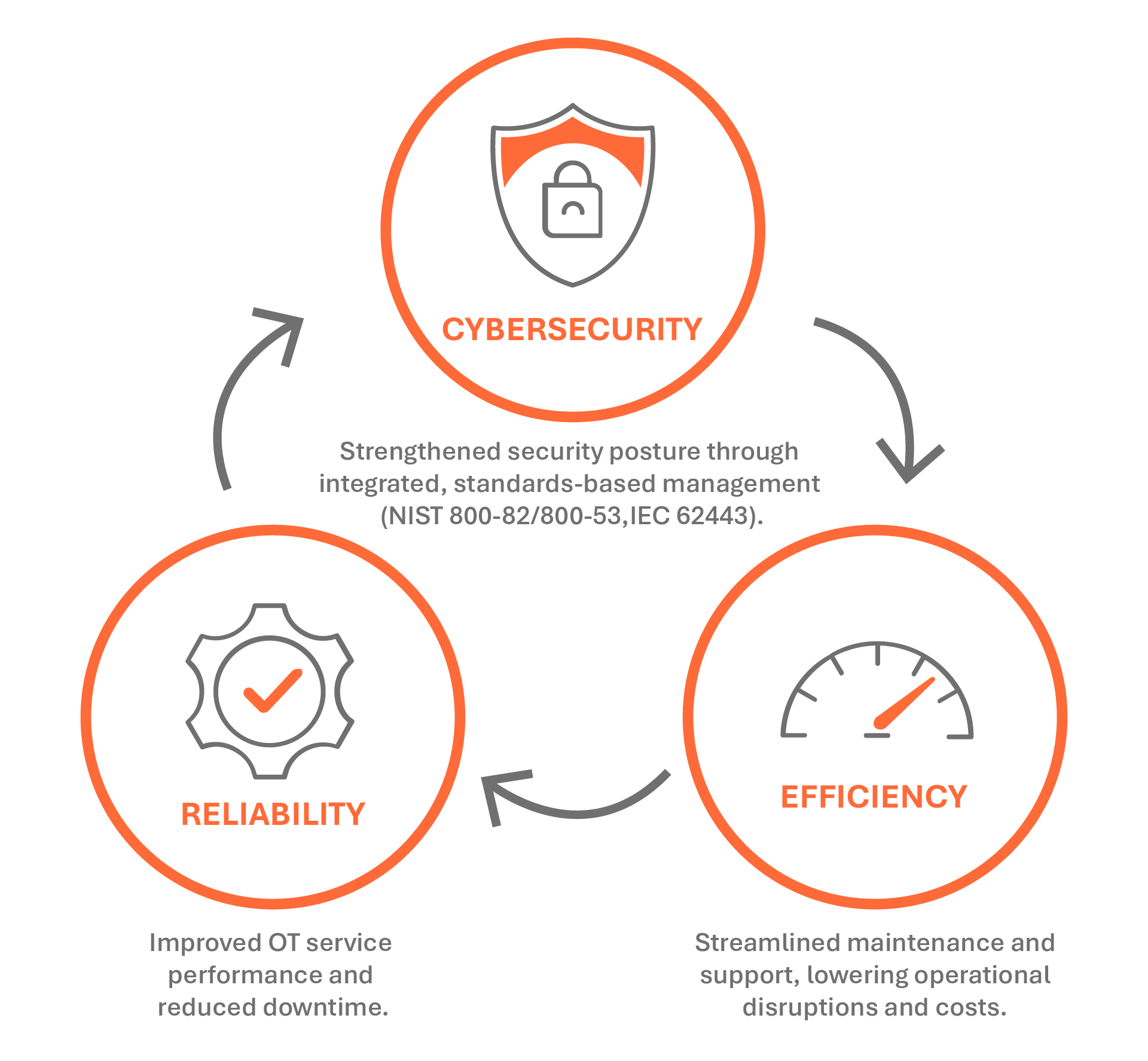
Figure 1: Service management evolution. A three-year implementation model guides SRP’s OT service management evolution, which will enable consistent services, align processes and support long-term operational resilience.

CLICK TO ENLARGE

As a key component of the service management strategy, 1898 & Co. worked with SRP to define a technology operations center (TOC) strategy designed to unify technology operations across disciplines. The model promoted shared governance, common service definitions and consistent processes, forming the foundation for SRP’s service management transformation.

Piloting Service Management in an OT Data Center

To validate the team’s vision, SRP and 1898 & Co. launched a greenfield pilot within the HSOC that focused on three key areas: reliability, cybersecurity and efficiency (Figure 2).

As a part of the pilot, 1898 & Co. led the design and implementation of foundational service management processes, including developing a service catalog, clearly defining business and technical services, and establishing continuous improvement practices aligned with the Information Technology Infrastructure Library (ITIL) and industry standards.

Figure 2: Desired expansion outcomes. The HSOC pilot provided a closed-loop test for expanding SRP’s OT service management that focused on cybersecurity, efficiency and reliability.

CLICK TO ENLARGE

Developing an OT Service Management Strategy and Road Map

1898 & Co. conducted a maturity assessment to evaluate SRP’s existing processes and identify improvement opportunities. From this, the team developed a future-state model and a phased plan prioritizing projects by business value and operational impact.

Because meaningful transformation depends on people, the plan included a strong organizational change management effort that engaged, educated, and aligned more than 500 SRP employees, helping them adopt new processes and build long‑term sustainability and success.

Following the successful HSOC pilot, SRP and 1898 & Co. developed a comprehensive OT service management strategy and road map that serves as a cornerstone of SRP’s broader OT transformation program. This established a scalable framework designed to:

  • Deliver standard OT services to improve consistency and operational efficiency.
  • Drive process alignment across OT domains for integrated coordination.
  • Strengthen collaboration between IT and OT through shared terminology, workflows, governance, and clear definition of roles and responsibilities.

Implementing the Road Map and Recognizing Quick Wins

With the road map complete, the partnership transitioned to detailed planning and execution. The plan was divided into three stages:

  1. Align and educate. Level-set OT teams on service management fundamentals and align goals with business priorities.
  2. Design and plan. Define detailed OT service management processes and finalize the implementation plan.
  3. Communicate and mobilize. Validate plans with stakeholders, establish governance and launch the multiyear program.

SRP and 1898 & Co. identified targeted, quick-hit initiatives, including refinements to service definitions, visibility and performance metrics. The quick wins delivered early benefits and built momentum for the broader transformation. Each success reinforced organizational confidence and helped to accelerate adoption of service management principles across the SRP power system. 

Results and Outlook

Through this partnership, SRP and 1898 & Co. established a unified service management framework that enhances operational reliability, improves cybersecurity and fosters collaboration across IT, OT and cybersecurity domains. The 1898 & Co. team delivered:

  • A clear, actionable strategy for advancing OT service management.
  • A validated model for HSOC service management.
  • A phased implementation plan to guide long-term improvement.

This engagement exemplifies how 1898 & Co. partners with utilities to translate vision into measurable business outcomes. By integrating service management across OT and IT technologies, SRP is positioned to operate more reliably, securely and efficiently, laying the groundwork for continued success in the digital era for energy.

Project Stats

Client

Salt River Project

Location

Phoenix, Arizona