Acquisition & Divestment
Asset Planning & Management
Business Strategy & Transformation
Data, Analytics & AI
Enterprise Technology
Operational Technology Services

Operational Technology Services



Trending

What We Do
Industries
Solutions

Canada does not have an infrastructure ambition problem. It has a delivery challenge. Governments, utilities and infrastructure owners are being asked to build faster, integrate cleaner energy and replace aging assets while keeping essential services reliable. But capital investment plans are expanding faster than most organization’s processes, which are often outdated or lacking, and labour markets responsible for delivering them. The current infrastructure challenge is equipping organizations with the capacity to deliver what Canada needs to build.
The pressure is visible across the country. Electricity Canada estimates that national electricity demand could more than double over the next 25 years, rising from approximately 600 terawatt-hours (TWh) annually to more than 1,200 TWh. Meeting that demand will require new generation, expanded transmission and distribution systems, and the modernization of aging infrastructure. Further, it is estimated that the sector will need to train, hire and retain up to 130,000 skilled workers for in-demand roles.
Growth on this scale tests more than funding. The organizations that will succeed are the ones that can demonstrate the governance, workforce and execution capacity required to deliver capital plans. That matters because what Canada is being asked to build, including new generation, expanded transmission and distribution, and the replacement of aging assets, is landing on organizations that are already managing existing assets and competing priorities.
Beyond additional funding, sound engineering and stronger project controls, closing this gap requires a systematic way for organizations to assess whether they have the strategic alignment and execution conditions needed to deliver their capital ambitions. Between strategy and a completed project lies the work, beginning well before projects are scoped and approved, that often determines whether infrastructure investments produce results:
These conditions should not be left to take shape once delivery is underway. They need to be assessed together, before commitments outpace the organization’s ability to fulfill them. This is where a delivery readiness assessment helps mitigate the gap.
Delivery readiness is an organization’s demonstrated ability to turn its infrastructure plans into working assets, measurable benefits and sustained operational outcomes. A delivery readiness assessment tests whether that ability exists, moving the conversation from what should be built to what the organization is actually prepared to deliver. At the centre of that test is delivery capacity: the combined ability of an organization’s funding, people, decision-making processes, supporting technology, supply chain and operations to execute its full portfolio of work at the pace the plan assumes.
Unlike a conventional project readiness review, a delivery readiness assessment examines not only whether an individual project has the conditions for successful execution, but whether the wider organization and portfolio can sustain the cumulative demands of delivery. Conventional project-by-project readiness can hide enterprise-level constraints: every project can look ready while the organization is not.
For leaders, the practical question is where delivery capacity will break first.
Consider a utility planning several major grid projects at once. Each project may have a sound business case and a technically viable design. Yet the portfolio can still stall if the same internal team members are needed on multiple projects, decisions take too long to reach the right leaders, procurement plans do not reflect long-lead equipment needs, or field execution depends on resources that are already committed elsewhere.
Those pressures can look like individual project problems at first. In reality, they often point to choices that must be made across the enterprise, assessing:
A delivery readiness assessment brings those decisions into view before they become delivery constraints. In practical terms, it provides leaders with a framework to test whether a capital program is prepared to move and where its ambitions exceed current capacity as well as what must change before schedules, budgets and public commitments harden. It is most valuable once an investment plan has been drafted but before it is submitted for approval or public comment, when sequencing, funding and resourcing can still change. It should then be repeated as conditions evolve.
Much of what follows draws on established program and portfolio management disciplines that utilities are likely already using, though often in separate parts of the organization. The value of a delivery readiness assessment lies in testing them simultaneously and holistically against the plan.
The following six stages trace a connected progression, each anchored by a question the organization must be able to answer. Strategic alignment and portfolio readiness set the direction while governance and organizational readiness create the conditions for delivery. Project execution readiness and benefits realization support execution, learning and sustained value. Because plans and conditions change, the progression is not a one-time sequence: Readiness has to be revisited and maintained as the program evolves.
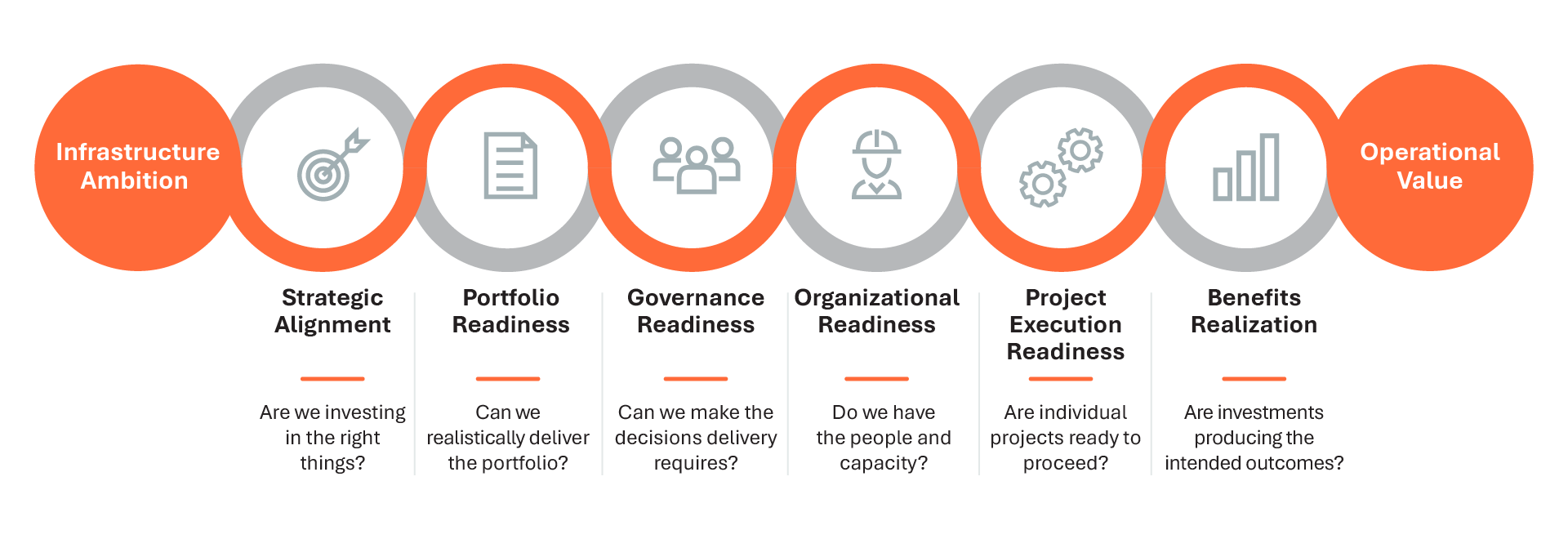
Figure 1: The six stages of delivery readiness form a connected progression, turning ambition into operational value. Readiness is revisited and maintained as plans and conditions change.
Strategic alignment: Each investment needs a clear reason to proceed, and leaders should be able to explain how a project supports the organization’s priorities, customer needs or regulatory requirements, and what result it is expected to deliver. That clarity matters when new demands arise and projects compete for attention.
Key question: Are priorities clear enough to make trade-offs when capacity runs out?
Portfolio readiness: A project can be independently viable while the full portfolio exceeds an organization’s delivery capacity ability to deliver capacity. This stage tests whether funding, workforce capacity, project sequencing, permitting realities, supply chain conditions and market availability support the plan as a whole. It also examines whether leaders have portfolio-wide visibility into dependencies, risks and resource demands, supported by consistent progress reporting. This visibility enables leaders to identify emerging constraints and re-sequence work before expectations become commitments.
Key question: Do we have objective (or well-informed) insight into our actual enterprise capacity, the tools to monitor it, and a sense of how aggregate demand fits within it, or doesn’t?
Governance readiness: Major programs require established internal processes, clear lines of responsibility and defined authority for decisions about cost, scope and risk. Project stage gates must set clear criteria for proceeding, with accountability for reviewing evidence and approving progression. Leaders and project teams need to know who owns each decision, what information is required and when issues must be escalated. These conditions help mitigate unresolved issues from delaying delivery.
Key question: What processes are in place to make sure decisions are made at the speed delivery requires?
Organizational readiness: Capital delivery changes the demands placed on people across an organization. New projects may require different skills, greater coordination with operations or sustained attention from leaders already responsible for day-to-day service. Assessing readiness means examining whether the workforce and leadership structure can support the work over time.
Key question: Do we have an accurate forecast of the role impacts, have we compared it to our resourcing model, and how will we know when we are approaching capacity?
Project execution readiness: This stage focuses on whether individual projects are prepared to move into delivery. Engineering, procurement, construction, program management and operational requirements must come together in a workable plan.
Key question: Can this project proceed with its major risks understood and the resources it needs available?
Benefits realization: Placing an asset into service is a milestone, but it is not the full measure of success. Organizations also need to track whether the investment produces the outcomes it was supposed to enable, such as added capacity, improved reliability, reduced emissions, enhanced resilience or better customer experience. This stage also tests whether the organization is prepared to sustain those benefits, particularly in the handoff from construction to operations. A project can succeed on scope, schedule and budget, but if the organization cannot achieve and sustain the intended outcomes, its reputation and its relationships with customers, regulators and employees are at risk. Those findings should inform the next round of investment decisions.
Key question: Are we measuring whether delivered assets produce the intended outcomes, are we prepared to sustain them, and are we feeding what we learn back into the next round of investment decisions?
These stages are connected, but they answer different questions. A utility might have strong project management practices while its portfolio schedule depends on the same specialists being available everywhere at once. Another organization might have the resources to execute but lack a clear process for deciding which project takes priority when market conditions, regulatory requirements or community expectations change. Assessing each stage helps leaders find the real constraint and address it directly. Because plans, markets and capacity keep changing, readiness is not a one-time checkpoint; it needs to be reassessed at key decision points and as the program evolves.
A systematic understanding of readiness gaps provides the basis for more informed and defensible delivery decisions. By identifying where capacity, governance, sequencing or execution conditions diverge from program requirements, leaders can prioritize targeted interventions, test critical assumptions and clarify decision ownership. Applied iteratively as programs evolve, this evidence-based approach can reduce uncertainty, mitigate delivery risk and improve the likelihood that projects achieve their intended outcomes.
In practice, the findings might lead an organization to re-sequence projects, strengthen decision rights, secure critical capabilities, revise procurement strategies or defer commitments until key dependencies are resolved. The objective is to make exposure visible early enough that leaders can act before it becomes embedded in the project.
That discipline becomes critical as organizations move from isolated projects to sustained capital programs. At that scale, delivery capacity must be designed deliberately rather than assumed project by project.
For Canadian infrastructure leaders, the right question isn’t whether more capital will be needed; it will. Rather, it is whether organizations can deliver on that capital investment while maintaining speed and discipline as well as the coordination required to execute. Leaders will need to continually reconcile ambition with executable capacity that produces lasting public value.


